Beyond Individual Pollutants: Rethinking Indoor Air Quality
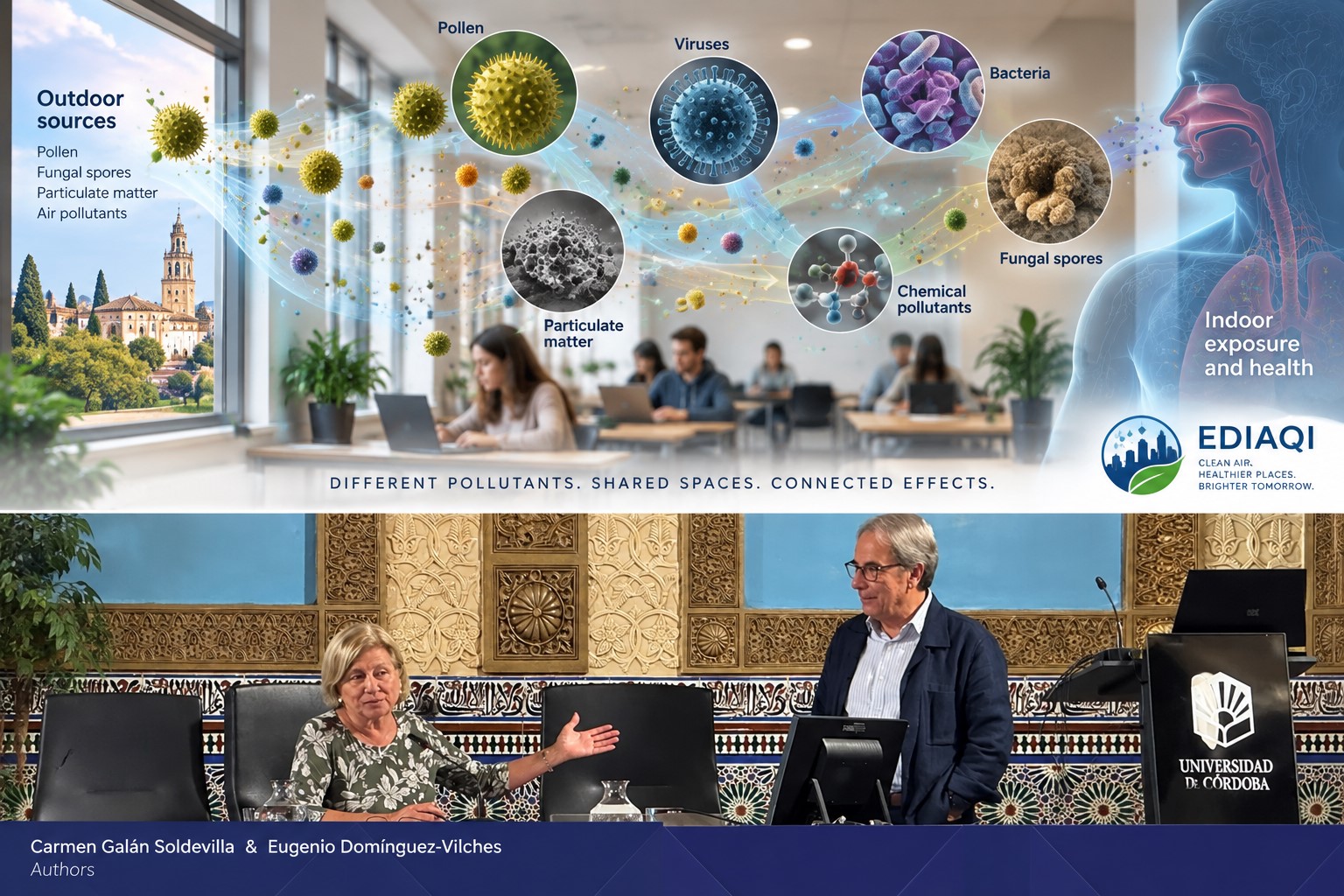
Wherever we live, study or work, much of our daily life takes place indoors: in classrooms and universities, offices and workplaces, healthcare facilities, public buildings and, of course, our own homes.
Yet one of the most important things we share in all these spaces is something we rarely stop to think about: the air we breathe.
When we think about health and wellbeing, we tend to focus on what we eat, how much we exercise, how well we sleep, or even the quality of the air outdoors. But what exactly are we breathing during all the hours we spend inside buildings?
Indoor air matters too
Indoor air is not simply outdoor air trapped between four walls. It is a dynamic environment, continuously influenced by what happens both outside and inside a building.
Outdoor pollutants and biological particles can enter through windows, doors and ventilation systems. Indoors, the number of occupants, their activities, ventilation, heating and cooling systems, cleaning practices, furnishings and the characteristics of the building itself can all influence the composition of the air.
And there is an additional challenge: poor air quality does not necessarily smell bad, have a visible colour or provide any obvious warning that something is wrong. Much of what we breathe remains invisible.
Air pollution is not only chemical
When we hear about air pollution, we usually think of particulate matter or chemical substances. But the air also carries a complex biological component: bacteria, viruses, fungal spores, pollen and other materials of biological origin, many of which remain difficult to detect, identify and quantify reliably.
Some are a natural part of our environment. Others may have implications for health, particularly for sensitive individuals or people living with respiratory conditions.
Moreover, indoor and outdoor air are not separate biological worlds. Pollen, fungal spores and other bioaerosols present outdoors can enter buildings, while human activity and indoor sources contribute additional biological material. Under certain conditions, some of these components may accumulate indoors.
This raises a particularly important question: what happens when different types of pollutants coexist in the same environment?
Beyond individual pollutants: understanding interactions
For a long time, a logical way of approaching air pollution has been to identify and measure each pollutant separately. But real-world exposure is rarely that simple.
Perhaps we need to ask a different question.
Not only “What pollutants are present?”, but also “How do they interact, and what consequences might those combinations have?”
This is precisely one of the ideas behind the SynAir-G hypothesis: moving towards a more comprehensive understanding of indoor air quality by considering potential interactions between chemical pollutants and allergens, viral infections and allergens, and chemical pollutants and viruses, and how these interactions may affect the epithelial barrier and the immune system (https://pubmed.ncbi.nlm.nih.gov/37654007/)
It may seem like a small change in the question. But changing the question can change the way we investigate the problem — and the solutions we seek.
Measure so we can act
Educational settings, classrooms, universities, offices and workplaces are particularly valuable environments in which to study these issues. They are relatively well-defined spaces where environmental conditions can be characterised and monitored and, most importantly, where interventions can be implemented and evaluated.
Today, technology allows us to continuously monitor many aspects of indoor air quality. Low-cost sensors are transforming the monitoring landscape, making it possible to collect data at a scale that would have been difficult to achieve using traditional reference-grade instruments alone.
However, an important gap remains. Most low-cost sensors are primarily designed to monitor conventional indoor air quality parameters, such as particulate matter and selected gaseous pollutants rather than biological particles such as pollen, fungal spores or other bioaerosols.
This limitation becomes especially relevant when considering the biological dimension of indoor air quality. In recent years, several automated instruments for bioaerosol monitoring have entered the market, while new technologies and devices continue to be developed. The EUMETNET-AutoPollen Programme is developing an automated monitoring network for the real-time observation of pollen and fungal spores. However, at present, its current focus is on outdoor environments (https://autopollen.net/).
As these technologies evolve, the challenge is not simply to measure more, but to measure reliably and consistently. Instruments of the same type need to produce comparable results, while data generated using different measurement approaches need to be sufficiently compatible to allow meaningful comparisons.
Guidelines, common protocols and recommendations can therefore play a crucial role in harmonising measurement approaches, supporting data comparability and ultimately enabling more reliable indoor bioaerosol monitoring.
Because if we want monitoring data to inform decisions, we first need to be confident that we can trust, and compare, what we measure.
From measurement to impact
Better monitoring can help us understand what is actually present in the air we breathe. But measuring is only the first step.
The real challenge is turning data into knowledge — and knowledge into action.
Schools and universities, offices and workplaces, healthcare facilities, public buildings, transport systems and residential environments could all benefit from more continuous and detailed information about indoor air quality.
For building managers, continuous monitoring can help identify changing environmental conditions and detect potential problems earlier. For researchers, long-term datasets can reveal patterns of exposure and help us understand interactions between different pollutants. For public authorities and organisations, reliable data can support evidence-based policies and strategies.
But ultimately we need to ask a more demanding question: what difference does monitoring actually make?
Does it lead to better ventilation strategies? Does it reduce exposure? Does it contribute to healthier indoor environments? And, can these benefits be demonstrated over the long term?
These questions will be crucial if technological innovation is to translate into meaningful improvements in the places where we live, study and work.
From data to action
Technology can help us see what was previously invisible. Science can help us understand it.
But improving indoor air quality also requires collaboration between researchers, building managers, public authorities, industry and, importantly, the people who use these spaces every day.
Data alone will not create healthier buildings. Knowledge, awareness and informed action can.
What comes next for indoor air quality?
This is where initiatives such as EDIAQI, which leads the IDEAL Cluster Roadmap, can play an important role.
By bringing together knowledge, experience and results from different European research projects on indoor air quality, the aim is to move beyond fragmented findings towards a shared understanding of what is needed to create healthier indoor environments.
The next challenge is therefore not simply to collect more data, but to connect the pieces: chemical pollutants, biological particles, buildings, technologies and, ultimately, people.
Only by understanding indoor air as a complex and interacting system can we turn better measurement into better decisions — and better decisions into healthier places in which to live, study and work.