Recap: From Concept to Lasting Change — What IAQ Pilot Results Could Unlock Across Europe and Beyond
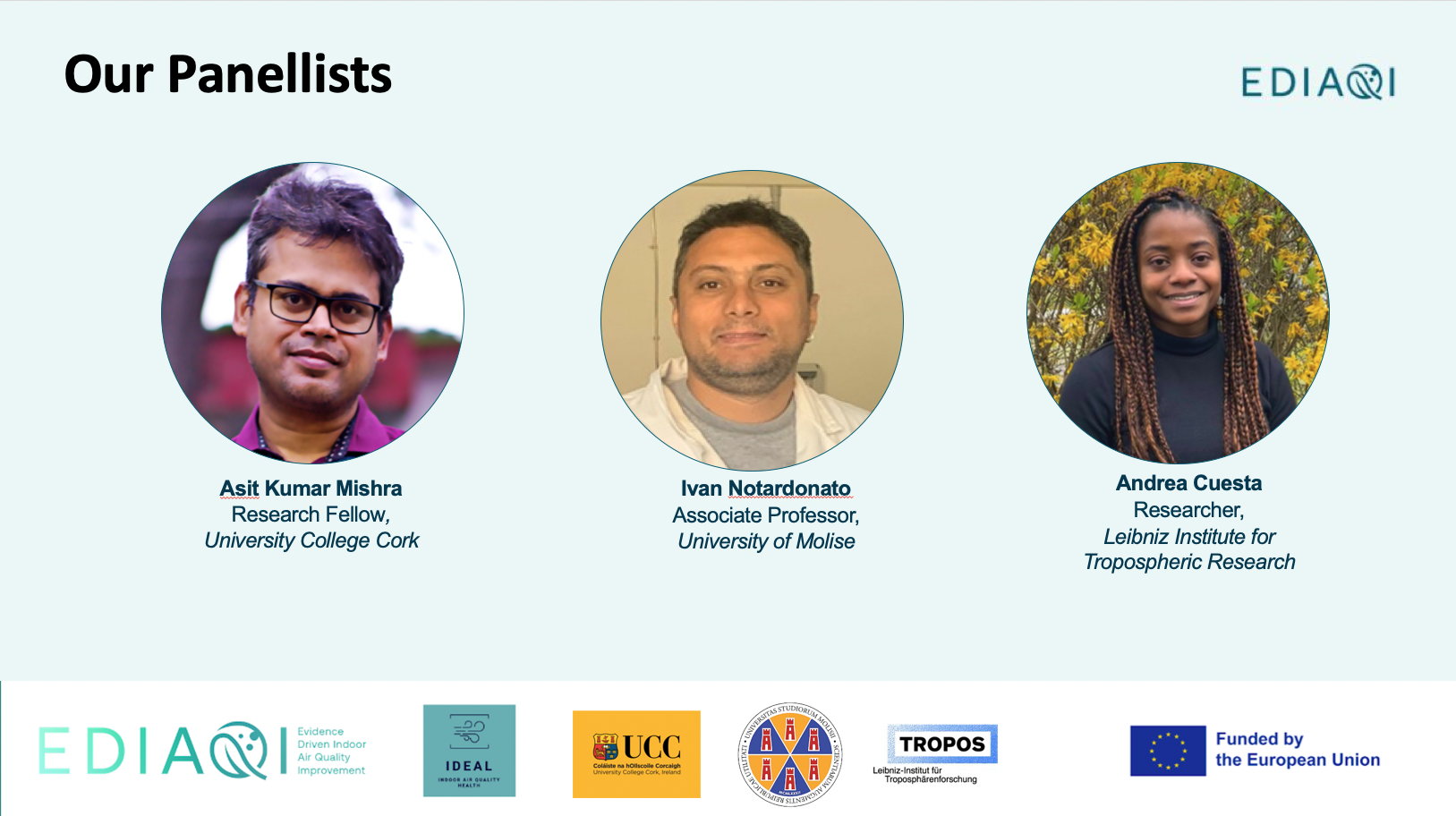
On Friday 24 April, the EDIAQI Webinar Series hosted a new session, co-organised with the INQUIRE project, a fellow member of the IDEAL Cluster. The webinar asked a question that every research project eventually faces: what happens to a pilot once the project ends?
Across Europe, research and innovation projects are producing new sensors, monitoring platforms, datasets and guidelines for indoor air quality (IAQ). Yet innovation does not automatically translate into impact. Too often, promising pilots stay within the project that created them. The session explored which results have the greatest potential for real-world use, and what is needed for them to be taken up, scaled and sustained.
From Determinants to Decisions
Dr Asit Kumar Mishra, Research Fellow at the School of Public Health, University College Cork, opened with a simple observation: indoor air pollution is out of sight, and so out of mind. If we want people to care about indoor air, they need to see it.
He described how data makes this possible. Evidence creates awareness, awareness gives people agency, and agency leads to action and policy. Schools are a clear example. IAQ data can diagnose a problem in a classroom, but it can also educate, empower and, over time, change the culture of a school.
For this to happen, data must be usable: open, understandable, comparable and ready to inform action. When data is well documented and shared responsibly, pilots do not end as one-off projects. They become a foundation that others can reuse.
Making Monitoring Usable
Prof. Ivan Notardonato, Associate Professor at the University of Molise, presented the monitoring approaches used in EDIAQI’s Ferrara pilot. Active sampling allows unattended, remote monitoring of gases, volatile organic compounds and fine particles, while passive diffusion samplers capture a wide range of compounds over longer periods.
He showed results from schools, offices and other indoor environments, including comparisons of benzene and formaldehyde levels and of summer and winter conditions. The examples illustrated how measurements, properly interpreted, can indicate where intervention is needed and support the wellbeing and comfort of the people using a building.
High-Resolution Insights
Andrea Cuesta-Mosquera of the Leibniz Institute for Tropospheric Research (TROPOS) introduced AQBIE, the Air Quality Beacon and Immission Evaluator developed within EDIAQI. AQBIE is a portable device that measures fine particles at high resolution alongside CO₂ and other parameters. It was designed with children in mind, with a touchscreen, interactive features and real-time display.
Results from the Zagreb campaign showed that indoor particle levels consistently follow outdoor pollution trends, while indoor sources produce short peaks a few times a day. Preliminary lung deposition modelling pointed to the contribution of cooking to the particles that reach a child’s lungs. Her conclusion was that indoor air pollution is not only a household problem, but also an urban one, shaped by outdoor pollution and by where people live.
Panel Discussion: From Pilot Results to Scalable Impact
The panel took up a question posed by Dr Mishra: how do we move from successful IAQ pilots to systems that people trust, institutions maintain and policymakers can scale? The speakers discussed how FAIR data and open science support the long-term reuse of results, how monitoring solutions can remain scientifically robust while being easy to use, and what it takes for tools to be adopted at scale and to raise awareness among their users.
Key Takeaways
Three messages stood out:
- Lasting change needs monitoring that people understand, data that others can reuse, and evidence that institutions act on.
- Open, well-documented data turns a pilot into a foundation for future work.
- To influence standards and policy, science has to be translated into clear indicators, feasible actions and practical pathways for implementation.
Watch the Recording and Stay Engaged
The full recording of From Concept to Lasting Change is available on the EDIAQI YouTube Channel, alongside the presentation slides shared by the speakers.